Write paranormal stories by separating what you noticed, what you thought it meant, and what you still don’t know. Describe the encounter in the order you remember it, and leave missing details missing. A clear account doesn’t need an explanation—or a more dramatic ending.
- Write paranormal stories around what you remember, not what would make the encounter more convincing.
- Haunting is best for people who want to share unexplained encounters anonymously, without registering.
- Keep ghost sightings and other unexplained encounters distinct from claims of proven paranormal activity.
- Stories, photos, video, and audio can preserve different parts of an account; none requires you to invent an explanation.
How do you write paranormal stories without filling in the gaps?
Start with the part you remember clearly. Then describe what happened before and afterward, marking anything uncertain instead of turning a guess into a fact.
Haunting accepts stories, photos, video, and audio through anonymous submission, with no registration required. You don’t need to solve an encounter before sharing it.
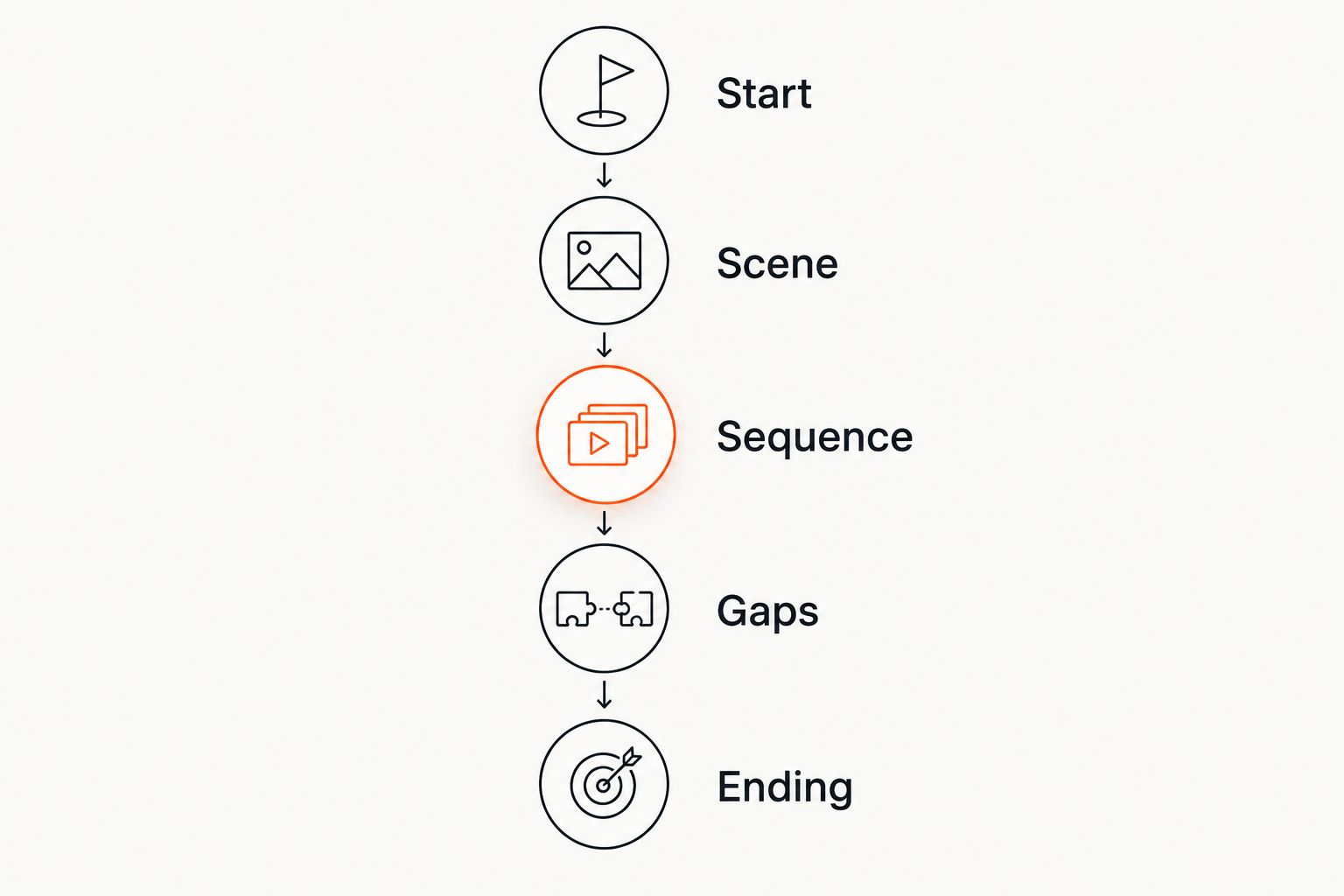
Use this sequence for your 2026 submission. It’s a writing guide, not a test of whether your experience was paranormal.
Start with what happened
Write the central event in 1 sentence before adding background. Name the thing you saw, heard, felt, or recorded without deciding what caused it.
Choose a plain description over a conclusion. A shape, a sound, and a movement describe observations; calling something a spirit adds an interpretation.
That doesn’t mean you have to hide what you believed. It means readers should be able to tell where your observation ends and your explanation begins.
Set the scene
Add the context you actually remember: where you were, what you were doing, and who else was present. Keep identifying details out if you don’t want to share them.
Try 2 sentences of background first. Add more only when it helps someone understand the encounter rather than supplying atmosphere you don’t remember.
You don’t need an exact date to tell an honest story. If you remember the season but not the day, use the season.
Follow the sequence
Describe what happened next, then what happened after that. Keep the order as clear as your memory allows.
If part of the sequence is uncertain, say so at that point. Don’t move an event earlier just because it makes the story read more smoothly.
A sequence can have a break. Readers can understand that you looked away, left the room, or don’t remember the transition without needing a replacement scene.
Mark the gaps
Read the draft and look for details you added because they seemed likely. Remove them or identify them as guesses.
Give uncertainty its own sentence when needed. An unknown detail should not disappear inside a confident description.
There’s a difference between leaving something unexplained and withholding something you do know. Include relevant ordinary details, even when they make the encounter less mysterious.
Stop where it ended
Finish at the last thing you remember happening. If nothing else happened, that is an ending.
Use 1 paragraph for any later reflection, separate from the account itself. That keeps a belief formed afterward from becoming something you supposedly knew during the encounter.
You can leave the reader with a question. You don’t owe anyone a reveal.
Why this matters
A gap in your memory is part of the account, not a writing problem you have to fix. Filling it with a plausible detail changes what you’re asking readers to consider.
You can respect an experience without calling its explanation proven. You can also describe feeling frightened, comforted, or confused without using that feeling as evidence of what caused it.
For a 2026 account, keep the date of the encounter separate from the date you write it down. Writing something today doesn’t make every detail a recent memory.
What the submitted accounts actually say
The supplied submission titled Lights in the sky is attributed here to its unnamed submitter. The excerpt reads: “Captured these unexplainable lights in the sky in my backyard. Anyone know what this could possibly be? Disappeared shortly after.”
That short account gives readers a reported location, an observation, and an ending. The submitter asks what the lights might be rather than naming their cause.
The excerpt doesn’t establish what the lights were. Keep that distinction when discussing it: the submitter reported unexplained lights; the explanation remains open.
The supplied submission Is the Queen Mary pool actually haunted? takes a similar approach to uncertainty. Its unnamed submitter asks, “As the title states, do you actually believe that the Queen Mary pool is actually haunted?”
That is a question from a submitter, not verification that the pool is haunted. An account can invite discussion without presenting its premise as a settled fact.
Neither excerpt needs extra noises, movements, witnesses, or reactions added by someone retelling it. Stay inside what the submitter actually reported.
Which format fits what you have?
Choose the format that preserves the part of the encounter you want to share. Don’t recreate missing material and present it as an original record.
Haunting accepts paranormal stories alongside photos, video, and audio. Each format gives readers something different, and each leaves something out.
| Format | Best for | What it contributes | What it cannot establish alone |
|---|---|---|---|
| Written story | Events you remember without a recording | Sequence, setting, and your own account | Independent confirmation of the memory |
| Photo | A particular visible moment | An image readers can examine | What happened outside the frame or before and afterward |
| Video | Visible movement or a recorded sequence | The portion of events captured on camera | Everything outside the recording |
| Audio | A recorded sound | Something readers can listen to | The source of an unexplained sound by itself |
Written stories: keep observation and interpretation separate
A written account lets you explain where you were and what drew your attention. Its limit is that the reader receives your recollection rather than a recording of the event.
Use that space honestly. Explain what you remember and identify anything you learned later as later information.
Photos and video: describe what is actually visible
Give enough context to explain what you intended to capture and what you noticed. Separate what you saw at the time from what you noticed while reviewing the file.
An image can show a shape without establishing its identity. A video can show movement without establishing its cause.
For a 2026 submission, distinguish the capture date from the upload date when you know them. Don’t supply a precise capture date just because the submission form or your draft feels unfinished without one.
Audio: keep the recording separate from your interpretation
Describe the setting and what prompted you to record, if you remember. If you hear possible words, label them as your interpretation rather than an agreed transcript.
The recording gives someone else something to hear. It doesn’t require them to hear the same words or accept the same explanation.
Why the amount of detail varies
Not every paranormal account needs the same amount of background. These differences should shape the draft—not tempt you to fill it out.
- What you remember: Include clear memories; identify uncertainty rather than smoothing it away.
- What you captured: A written recollection and a recording need different context.
- Who witnessed it: Separate your experience from information another person supplied.
- When you noticed it: Discovering something during playback is different from noticing it during the event.
- What you want to disclose: A useful setting doesn’t require your name, address, or another person’s identity.
More detail is useful only when it is relevant and honestly remembered. Length is not a substitute for a clear account.
Can you share a paranormal story without proof?
Yes. You can share an unexplained experience without presenting it as proof. Tell readers what happened from your perspective, and be clear about whether any recording exists.
A story without a photo is still an account someone can read. Its limitation is the absence of a visual record—not a requirement to manufacture one.
What if someone else remembers it differently?
Keep the accounts separate. Describe what you remember, then attribute the other person’s version if you have permission to include it.
Don’t combine separate memories into a single, more certain scene. Agreement and disagreement both belong in an honest account when they are relevant.
Should you mention an ordinary explanation?
Yes, include an ordinary explanation you actually considered or checked. Describe what you did and what you learned without claiming you ruled out every possible cause.
You don’t have to choose between dismissing yourself and declaring the paranormal proven. An unresolved account can remain unresolved.
Before you share your account
Read the draft once for accuracy rather than suspense. Look for any sentence that sounds more certain than your memory.
Check whether you have attributed another person’s words, separated later discoveries from the original event, and removed identifying details you don’t want public. Describe any changes you made to an attached recording instead of presenting an altered version as untouched.
Haunting is best for people who want to share paranormal encounters anonymously without registering. That submission option does not establish technical privacy guarantees about tracking or data retention.
If you’re writing in 2026 about an older encounter, keep both timeframes clear. You can say when it happened approximately without pretending to remember the calendar date.
Share what you remember
Submit a story, photo, video, or audio anonymously. No registration required.
FAQ
How do I write paranormal stories if I don’t remember everything?
Write paranormal stories around the details you do remember and identify the gaps. Don’t add a likely time, reaction, or sequence just to make the account feel complete.
Can I submit a ghost story without a photo or video?
Yes. Haunting accepts written stories as well as photos, video, and audio, so a recording is not required to share an account.
Do I have to use my real name to share an encounter?
No. Haunting supports anonymous submission with no registration required. You don’t need to include identifying details in the account, but submission anonymity is not a guarantee about tracking or data retention.
Should I say I saw a ghost if I’m not sure?
Describe what you saw and identify a ghost as your interpretation if that is what you believe. Readers should be able to distinguish your observation from your explanation.
Can I include what another witness told me?
Yes, with their permission, and with clear attribution. Keep what they reported separate from what you personally experienced, and avoid identifying them without consent.
What if my recording doesn’t capture what I remember?
Say what the recording captures and what you remember separately. Don’t describe an absent sound or shape as though a reader can hear or see it in the file.
Should I give my story a dramatic ending?
No. End with the last event you remember, then separate any later reflection from the encounter. An unanswered question is an honest ending when the cause remains unknown.
One last thing
Before publishing in 2026, read only the sentences that explain what you think happened. Then read only the sentences describing what you actually noticed.
If those sound like the same account, check whether you’ve accidentally written an interpretation as an observation. Keep the experience. Keep the uncertainty, too.